Archives
Pamiętnik Literacki 4 / 2025
Pamiętnik Literacki 4 / 2025
 Co-financed by the Minister of Culture and National Heritage from the Culture Promotion Fund.
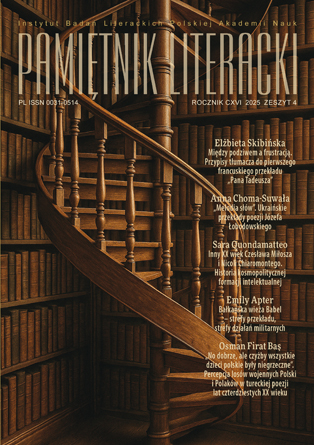
The present study focuses on the footnotes to three successive editions of the first French translation of “Pan Tadeusz” (“Master Thaddeus)” by Adam Mickiewicz, viewed as a material that allows for reconstructing the relation between the translator—Krystyn Ostrowski—and the poet. The content of the footnotes, complemented by elements of successive forewords to the translations of Adam Mickiewicz’s works published by Ostrowski picture the relation as a pathway from admiration and fascination with the poet’s output to disillusionment and frustration caused by his activities in exile, yet strengthened by the translator-patriot life experience, by the feeling of disappointment and injustice, and by political beliefs. The analysis matches up to the thesis that the translator’s footnotes create a space where his partiality and subjectivity are revealed. In this case, the translator is not allied with the original author and his work.
The article discusses the work of Józef Łobodowski and its Ukrainian translations, which have gained popularity in Ukraine, particularly in the context of the “Pieśni o Ukrainie” (“Song of Ukraine)”. The translations, made by such poets as Leonid Poltava, Jar Slawutych, Bohdan Kravciv, and Myron Borecky, aim to understand the common Polish-Ukrainian roots and to reflect on the history of both nations. As a poet striving for reconciliation, Łobodowski draws on romantic traditions, which reflects in his output. The translations not only enrich Ukrainian literature, but also allow for a reinterpretation of Polish and Ukrainian historical relations. The article also emphasizes the diversity of translation styles and their artistic value, contributing significantly to intercultural dialogue.
Referring to Wojciech Karpiński’s intuition, the author of the paper aims to trace the spiritual and intellectual affinity of Czesław Miłosz and Nicola Chiaromonte as members of “a special intellectual formation.” The researcher strives to delineate the complexity of their encounter, which was determined by specific historical-political and cultural situation, thus analysed from a comparative perspective. Closeness of Miłosz and Chiaromonte’s thoughts results not only from the figures’ participation in the same events or from living in the same political climate of the 20th century, but also from the writers’ attention paid to define the aesthetic bases of freedom of thought, language, and human action in the context of massification and totalitarian ideologies that led to destructive consequences. The article shows the mode in which Miłosz and Chiaromonte’s initially divergent research when it comes to social-cultural horizons helped them collectively discover the tragical dimension of history and set them against these forms of 20th determinisms that made human being an isolated monad subordinated to the requirements of the needs of various historical necessities.
In her paper, Emily Apter defines “translation zone” as a war zone, by showing resemblance between war mechanisms and language structure and policy in the regions with high language diversity, where there are long-standing feuds over not only territorial, but also linguistic borders or dominance of one language or dialect over the other. Discussing selected novels by two authors—an Albanian writer Ismael Kadare and a Bosnian-born Ivo Andrić—Apter turns to the sphere of social semiotics, which is deeply rooted in tribal customs and ancient legends of the Balkan peoples, paying attention to cultural untranslatability between the East (Islam) and the West (Christian tradition). Inspired by the mode in which monolingual (not only Balkan) nations protect the internal borders of their language, Apter provides insights into the issues of linguistic standards and political attempts to impose them against the increased diversity and multilingualism. A manifestation of this kind of language policy is visible in the domination of English in the globalized world, the example of which is nuclear English that leads to excessive simplification of language through depriving it of cultural elements, which may remind of the still-reviving idea of artificial language that might overcome the cultural and political differences.
This paper presents the reflections of Poland’s and Poles’ wartime fate during WWII in the Turkish poetry of the 1940s, thereby bringing closer to the Polish reader—even in fragments—some pieces by Turkish poets whose works have never before been translated into Polish. The first version of the text was a presentation prepared for the 10th Conference of Turkology organised by the Chair of Turkish Studies of the Jagiellonian University in Cracow, on 10–11 October 2024. The text and particularly the translations of the poems were edited by the Polish writer Andrzej Juliusz Sarwa.
Constancy”) 4 / 2025
The authoress makes Justus Lipsius’ work “De constantia” (1584) in its old-Polish translation by Janusz Piotrowicz entitled “O stałości księgi dwoje” (1600) (“On Constancy in Two Books”) the subject of her paper. She analyses the specificity of translating the Latin text into Polish with special attention paid to literality as a translation method. Referring to the textual material, she demonstrates that this method requires deep understanding of cultural and intertextual context to make it a valuable instrument for rendering the original sense and rhetorical property. On selected samples of Piotrowicz’s translation she shows how literality may stress, enrich as well as impede interpretation of the text. Carrying out a comparative analysis, she shows that faithful reproduction of translation basis does not always guarantee complete agreement with the lexis and semantics of the original work, and that it may lead to misunderstanding, trivialization, and even total deformation of the original author’s intention and the source text.
Justyna Dąbkowska-Kujko reveals and accentuates the essence of Piotrowicz’s preserving the lexical, stylistic, and conceptual fidelity, emphasising at the same time that literality, although a great advantage, may sometimes lead to overinterpretation or to generating metaphorical structures that are absent from the source text. Conclusions indicate that faithful reproduction of a Latin text into Polish should not solely result from proper understanding the original language anchored in context and referring to specialist terminology of the source text, but it also is a philosophical and aesthetic issue, it calls for precision, vigilance, for a deep reflection upon the translated work and its intercultural and polysemantic potential.
In 1951, a social-literary weekly “Wieś” (“Country”) published a set of George Gordon Byron’s six poems translated by Sławomir Mrożek. The print remains almost forgotten episode in the Polish writer’s output. The poetic collection was complemented by Leszek Herdegen’s commentary. The author of the article analyses the political contexts of the publication and deals with translation criticism while comparing Mrożek’s translations with other Polish versions of Byron’s poems.
The paper is a continuation of the text published in „Pamiętnik Literacki” („Literary Memoir”) Issue 2/2025 and refers to genres understood as peculiar models of reality. This part refers to the problem of transposing the literary form and the vision of reality connected to it into the sphere of painting and music. The possibility of such a transposition is for Witold Sadowy an important feature of what he refers to as Generic Worldview (GW). Entering into a polemic with the scholar, the author focused primarily on the limitations of such actions, seeing in it not so much a symmetric transposition of GW, but its interpretation which, consequently, (due to the specific nature of painted or musical sign) undergoes another interpretation performed by the receiver. In the coda, the author postulates emergence a trend of GW research that would focus not on reconstruction, but on the analysis of already formulated GW in various discourses and arts.
In its purpose, the article adds to the present knowledge about Dionizy Piotrowski’s translational-literary activities and the figure himself—a barely known 19th c. Polish translator, who while on emigration in France after the fall of The November Uprising rendered into Polish a Portuguese Renaissance epopee by Luís Vaz de Camões (ca. 1524–1580) entitled “Os Lusíadas.” The translation, made around 1875, was given the title “Lusiady albo Portugalczycy” (lit. “The Lusiads or the Portuguese”) and still remains on the margin of research in Portugal Studies.
The paper resolves the doubts and fills the blanks in the translator’s biography as well as in the broadly understood circumstances of composing “Lusiady.” The fundamental source employed by the author is Piotrowski’s correspondence treasured in the Jagiellonian Library in Cracow, since the material is absent from earlier studies. This source is complemented by Piotrowski’s letters to The National Library of Lisbon and paratexts that accompany “Lusiady.”
Letters of Oktawia Głowacka, the writer’s wife, and those of other people, both printed and unpublished, as well as interviews and memoirs, provide many small, yet important insights into the everyday life of this couple and into the contribution of the writer’s wife to the creation of many of his novels. They picture an image of a woman-protector of her husband’s good name, a faithful guardian of his legacy and memorabilia, and finally a continuator of the work of awarding the Bolesław Prus scholarship for the education of children from peasant families.
The paper is an edition of the unpublished in full to this day correspondence between Eliza Orzeszkowa and Franciszek Olszewski—the editor-in-chief of “Kurier Warszawski” (“Warsaw Daily”) written between 1887 and 1896. The letters come from the archive of most widely read Warsaw daily that survived in fragments. The material, stocked in the Archive of the Polish Academy of Sciences, has catalogue number 162. The presented collection deserves attention due to at least a few following reasons. First of all, it fills the blanks in the presumably well-known biography of the outstanding woman writer. Second of all, the letters enrich the incomplete characteristics of Franciszek Olszewski as an editor. Third of all, the set pictures the specificity of press functioning and the attempts made by their editors to keep so-called column section on the highest level. Additionally, it indirectly offers an image of the Warsaw literary-journalistic community, disclosing the insight story of conflicts between the author, the critic, and the editor that have not been discussed until now.
The aim of the article is primarily a reconstruction of events from the first part of the year 1900 (and their consequences), namely of the time when Władysław S. Reymont stayed in Zakopane and started a relation with Wanda Szczykowa, de domo Starzyńska. The paper contains not only pieces of information about their liaison and its perturbations, but it also attempts to reconstruct Reymont’s intellectual and artistic activities week after week, with respect to situational and social contexts. These issues have not until now been researched.
In principle, the paper is of verificatory, corrective, and complementary character (due to new sources and renewed detailed analysis of Zakopane press) to the previous establishments, due to which episodes from the writer’s life can be provided with details.
The paper contains an edition of unknown to this day Reymont’s letters to Szczukowa treasured in the collections of the Royal Castle in Warsaw.
The review deals with the version of Homer’s “Odyssey” polonised by Antoni Libera. Referring to specific examples, the reviewer points at the “translator’s” unconcern in building the proper hexameter in Polish and his inability in rendering the style and content of the original text.
It is an assessment of Weronika Szulik’s book “Konstelacje Romana Jaworskiego. Witkacy, Irzykowski, Brzozowski (Roman Jaworski’s Constellations. Witkacy, Irzykowski, Brzozowski,” Warsaw 2024). The reviewer offers a deep insight into the concept of constellation proposed in the book and inspired by theories formulated by Theodor W. Adorno and by Ryszard Nycz. The discussion of most vital issues of the study allows for answering the following questions: to what extent the method employed by Szulik permits Roman Jaworski’s new reading the output of “Young Poland’s dandy,” and what “constellational thinking” reorientates within the framework of a classic monograph devoted to one author.