Archives
Pamiętnik Literacki 2 / 2026
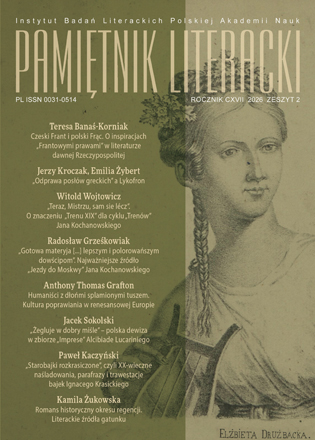
Pamiętnik Literacki 2 / 2026
 Co-financed by the Minister of Culture and National Heritage from the Culture Promotion Fund.
The paper aims both to reinterpret the research theses formulated in the 1950s referring to the impact of the Old-Czech “Frantova práva” (“The Statutes of Franta”) on Old-Polish authors, and to present, based on the analysis of the survived Old-Polish literary accounts, the extent to which “The Statutes of Franta” inspired the native men of letters. Bearing in mind that the old makers of popular literature preferred the form of literary parody, Teresa Banaś-Korniak proves that they referred to “The Statutes of Franta” in various ways, depending on the cultural circumstances and expectations of the Polish receiver. Not only did they faithfully reproduce the content and the sense of the Czech piece (Polish translation), but also developed and freely adopted the original plot and motives; nevertheless, Polish utilitarian and literary genres largely used the parody as their basis, while references to the Czech work were limited to borrowing motives and threads. The only text that can be labelled a parody of “The Statutes of Franta” is an anonymous “List wolny i przywilej frantowskiego cechu” (“Free Letter and the Right of Franta’s Guild”).
The article refers to the relationships between Jan Kochanowski’s Renaissance tragedy “Odprawa posłów greckich” (“Dismissal of the Greek Envoys”) and a Hellenistic poem “Aleksandra” (“Alexandra”) by Lycophron. To a set of arguments for such connections presented in 1884 by Józef Kallenbach, the authors of the paper add a few more that relate to the terms used by Kochanowski and to the form of the two texts. They also explain the philological riddle: the reason why the ship of Paris that conveys Helen is called in the Polish tragedy “a beech boat.”
In the article, I analyse the significance of the motto (“Tales sunt hominum mentes, quali pater ipse / Iuppiter auctiferas lustravit lumine terras”—a fragment of Odysseus’s reflections from the 18th book of the “Odyssey,” verses 136–137, quoted by Jan Kochanowski in the Latin translation of Cicero from “De fato”) for the worldview and rhetorical structure of “The Laments” (“Treny”). Through multiple references to the motto within this poetic cycle, the Ciceronian consolatory tradition is reinterpreted, as are, more broadly, the values of the Renaissance humanism and the traditions of Stoic anthropology. These issues refer to the role of the “true,” “prophetic” dream—its meaning in “Lament 19, or: A Dream.” The experience of Jan’s “true” dream reflects a pattern of beliefs accepted by the author and his contemporaries. “Lament 19” resolves earlier lines of thought, returns to images and expressions from the preceding “Laments,” renews them in a different form, and provides answers to questions posed in the earlier poems. On a metapoetic level, the author demonstrates that self-referentiality of “Laments” consists in their foreshadowing within the mother’s visio in “Lament 19,” they come into being as Kochanowski’s fulfilment of his mother’s command: “Now, master, you will have to heal yourself.” In essence, the cycle “begins” with “Lament 19.” Through it, the mechanism of recapitulation is revealed, leading to a radical transformation in the subject’s attitude toward God and the death of his daughter, Urszula.
As early as in the 19th c. attention was paid to the fact that the detailed portrayal of a sabotage expedition into the Grand Principality of Moscow led by Krzysztof Radziwiłł “Piorun” (“Lightning”) given by Jan Kochanowski in his “Jezda do Moskwy” (“Incursion into Muscovy,” 1583), both in the operation’s fact and data and the exhaustive description of troops’ itinerary, must have been based on a diary of the expedition’s member. Radosław Grześkowiak proves that the source text was Andrzej Rymsza’s manuscript “Deketeros akroama, to jest Dziesięćroczna powieść wojennych spraw […] Krysztofa Radziwiłła […]” (“Deketeros acroama, that Is a Ten-Year Story about […] Krzysztof Radziwiłł’s War Issues […]”). Though the printed piece appeared only in 1585, its recording completed on April 10th, 1583. Krzysztof Radziwiłł, who ordered “Incursion” from Kochanowski, must have had this book at his disposal and it was him who provided the volume to the Polish poet. The dependency allows to specify the time of producing the poem: referring to the title page, it was composed in 1583; the latest information is more specific: between end-of-April and November 1583 to give the typographer, Jan Januszowski, time to publish the print in Cracow before the end of that year.
Anthony Grafton in his lecture presents a working method of Early-Modern correctors whose job entailed pre-publication reading and revising texts in publishing houses. Referring to numerous sources from the epoch, the researcher indicated that many a time the correctors’ interventions into the texts were far-reaching since they assumed responsibility for the social reception of the work and the public image of the author. At the same time, majority of correctors was much respected neither by their employers, nor by readers, nor by scholars whose treaties they revised. It resulted in low salaries and common dissatisfaction from their fortune, though the job required necessary language predispositions and erudite humanistic knowledge. Grafton also demonstrates that the origin of this profession is linked to circulation of Latin manuscripts and dates back to the late Middle Ages in Italy where the ethos of correctors as well as the basic methods of their work developed, and where arose the convictions that correctors are co-authors of published texts, and that the final shape of the work depends on their commitment.
The second part of Alcibiade Lucarini’s collection “Imprese dell’offitioso accademico Intronato (Imprese of the Obliging Intronato Academic” <Siena 1629>) is equipped with a Polish motto “Żegluje w dobry miśle [Splashes happily]”—a clumsy translation of the Italian sentence “Guazza alegramente.” It is most probably the only known example of a Polish maxim found in West-European collections of this kind. It is accompanied by a mysterious water bird called “laco” (Lat. lagus) of which Lucarini gained information from a popular medical encyclopaedia “Hortus sanitatis.” He could also have referred to a work by Olaus Magnus published in Rome in 1555 that depicted ethnographical and natural peculiarities of Northern Europe, and to maintain the local colour he decided to give this wood engraving the Polish inscription.
Among the relations to Ignacy Krasicki’s output in Polish 20th c. literature, those to fables prove most frequent. The imitations are characterised by departure from universalism and parable pattern for actualisation merged with strengthening the satirical blade. At the same time, the analysed pieces reveal a vast array of plays with tradition: from the classical pastiche to constructions that remind of contemporary sampling practices. Mentions to Krasicki’s fables serve various purposes: a display of literary art of imitation, a political satire, unrefined joke. In each case knowing the reference point is indispensable, or at least desirable. Regardless of what we face—a classical literary emulation or juggle with quotations and intertextual allusions—Krasicki’s fables were the necessary condition of producing them.
The paper assumes that the popular historical romance of the regency period is a subtype of the historical novel and at the same time a continuation of women literature. The aim of the examination is to present the most vital sources of the regency romance, namely the historical novel (to which the romance belongs) or ahistorical writing of Jane Austen—an exemplar of narrative form that prevails in the romance and a model of male-female relationship portrayal. Additionally, the article describes the concept of now forgotten genre “silver fork novel” which also proves influential on the modern historical romance. Observations made in the study allow to include the historical romance into a rich, though rejected and disparaged tradition of women literature.
The study examines the Polish translation of a renowned anonymous sonnet from the Spanish Golden Age, the incipit being “No me mueve, mi Señor, para quererte / No me mueve, mi Dios, para quererte” (“It doesn’t move me, my God, to desire you”), sometimes misattributed to St. Francis Xavier, among others. Authored by the Jesuit Tomasz Elżanowski, the translation was published in “Akty i afekty cnót. Setnik pierwszy o miłości” (1646), a Polish adaptation of Giovanni Rho’s “Degli atti ed affetti delle virtù: centuria prima dell’amore” (“Acts and Affects of the Virtues: First Century of Love,” 1644). Elżanowski’s rendition of the poem, based on Francesco Sforza Pallavicino’s Italian version, diverges from the sonnet’s formal structure, presenting it as a fourteen-line, paired-rhymed poem in eleven syllables. This translation holds historical significance as the earliest known and published Polish rendition of Castilian poetry, providing valuable insights into the sonnet tradition and its adaptations within early modern Polish literature, while also underscoring the cultural contributions of Jesuit translations.
The study describes Samuel Twardowski’s epigrams composed in the last period of his life. Though the autobiographical apothegm was known to this day, the author of the paper suggests minor modifications in its transcription, alongside of new interpretive remarks. Additionally, Roman Krzywy delivers an edition of Twardowski’s four further (handwritten) epigrams: three devotional and one autobiographical.
The aim of the article is to present the aesthetic values of selected handwritten prayer books from the 17th c., kept in the archives of the Norbertine Sisters in Cracow. These manuscripts were crafted very carefully, with great care for the text legibility and the quality of decorative motifs. Attention is focused not only on the aesthetics of the handwritten text (paper, ink), but also on illustrations and decorativeness. The aesthetic values of the manuscripts visible on the ornate title pages, in the calligraphic type of handwriting, and other details with which the manuscripts were inlaid, are emphasised. The considerations highlight the fact that that writing in a manuscript is a tool for organising words and ideas and a way of influencing recipients, while miniatures, initials or prints serve to decorate and complete main text.
Archiwum Prowincji Polski Południowej Towarzystwa Jezusowego w Krakowie (The Archive of Southern Poland Province of the Jesuit Society in Cracow) stocks a manuscript of 166 pages with 6264 verses entitled “Poemat o powstaniu Kościuszki, zakończony »Kantem żałobnym Ojczyzny straconej ku niewdzięcznemu Królowi zdrajcy«” (“A Poem on the Kościuszko Uprising That Ends with »A Mornful Cantata of the Lost Motherland to Ungrateful King Traitor«”). The piece to this day has not been subject to academic research, even though it belongs to the most representative text of 1793–1806 occasional literature, and is viewed as a peculiar summary of the motifs, themes, literary and stylistic forms as well as emotional tones found in poems and verses of partitional and after-partitional poetry. The anonymous author composed the work in his normal course, in line with the spread of the Kościuszko Uprising and the international events connected with it. It may be an exceptional source of information about the thoughts of the Poles from January to autumn 1794.
The paper attempts at an analysis of a few key vital issues, namely the piece’s authorship, its genetic distinctiveness, ideological potential, and historical-ideological context.
The article refers to Elżbieta Drużbacka’s literary pieces written on the sheets of two manuscripts currently preserved in the Jagiellonian Library in Cracow and in the National Library in Warsaw. Initially both of them made up one unit—allegedly lost after the World War II Antoni Lange’s cartulary, a transcript of a destroyed codex (signature 829) of the Krasiński Library. The cartulary contains 51 pieces by Drużbacka, 26 of which were completely undisclosed or known only from a title. The discovery markedly broadens the canon of the 18th c. poet and delivers new information about the figure. Additionally, the paper discusses the role of Lange as a critic and editor of Drużbacka’s writings.
The aim of this article is to present an excerpt from a manuscript by Jan Stanisław Jabłonowski, found in the collection entitled “Jana Jabłonowskiego Wojewody Ruskiego różne zabawy” (“The Various Plays of Jan Jabłonowski, a Ruthenian Governor” <manuscript BCz 1147 IV>). The composition and content of the piece suggest that this unpublished work by the Governor of Ruthenia was close to the Messianic genre, focusing on depicting specific Biblical scenes, with particular emphasis on the Passion and death of Jesus Christ.
The article examines the poetic works of Wincenty Koźmian (1770–1851), brother of Kajetan Koźmian, whose literary output has so far been marginalised in historical-literary research. Based on four unpublished letters from 1826 preserved in the collections of the Hieronim Łopaciński Provincial Public Library in Lublin, the author analyses the formal, thematic, and stylistic aspects of these epistolary texts in verse. The study highlights their roots in the classical literary tradition, the presence of rustic, satirical, and panegyric motifs, and their role in maintaining family and community ties. The source edition included in the appendix presents Wincenty as a representative of the literary culture of the landed gentry in the Kingdom of Poland.
The review assesses Magdalena Komorowska’s monograph “Piotrkowczykowie. Z dziejów drukarstwa krakowskiego przełomu XVI i XVII wieku” (“The Piotrkowczyks: from the History of Cracow Printing at the Turn of the 16th – 17th C.,” 2023) on book history, devoted to the history of the Cracow printing house—Piotrkowczykowie. The book includes an innovative analysis of publishing production that indicates the number and format of printed sheets. The highest value of the book lies in viewing the analysed problem as an argument in a discussion on the role of the catholic book in the development of printing that leads to challenging the opinions fixed in the state of research.
Izabela Wiencek-Sielska’s monograph “Przekreśl, wytnij, zaszyj. Siedemnastowieczny cenzor ‒ studium przypadku” (“Cross out, cut out, sew on! The Case Study of a 17th Century Censor,” 2024) is a comprehensive and erudite study dedicated to a unique collection of old prints from the library of The Jesuit College of Łomża, and to the activities of its carer and guardian—Andrzej Obrembski. The author, analysing the traces of the censor’s reading and interfering into hundreds of volumes, reconstructs his workshop and discloses the mechanisms of book culture functioning and the control of ideas circulation in the post-Tridentine epoch. The paper combines a microhistorical perspective with a broad historical-literary background, offering various establishments referring to reading, censorship, and the 17th c. intellectual life. At the same time, it offers a methodological guide to research in old books and its users.
The review refers to Radosław Grześkowiak’s study (“A Guide to the Heavens. The Literary Reception of Herman Hugo’s »Pia desideria« in the Polish–Lithuanian Commonwealth,” 2023) on Polish (handwritten, printed and decorative) translations and adaptations of fragments from a Dutch Jesute Herman Hugon’s book Pia desideria (1624). The assessment points at, inter alia, Radosław Grześkowiak’s observations that broaden the knowledge on emblematic literature in the First Polish Republic and on the methodological assumptions that prove vital to emblem studies.
Literary historians researching Wacław Potocki’s vast output have to this day rather disregarded “Odjemek od »Herbów szlacheckich«” (“A Fragment of »Heraldry«”), viewing it only as a peculiar addition to, nomen omen, “Poczet herbów” (“Heraldr”y) written in verse and published in 1696. Editors have treated “Fragment” with similar neglect; when preparing selection of the Baroque writer’s works, they either omitted the collection altogether or included morely a few text from it, while the only 1997 edition to this day contains numerous errors. All those deficiencies are corrected by Dariusz Piotrowiak’s superb monograph (2023) where reliable remarks included in genuine introduction and in “Komentarz edytorski” (“Editorial Commentary”) are followed by almost faultlessly given complete collection of texts with conscientious footnotes. The book restores Potocki’s work to the Polish reader.
Teresa Kostkiewiczowa’s latest collection of papers entitled “Wokół oświecenia. Studia i szkice” (“On Enlightenment. Studies and Sketches,” 2024) is synthesising in nature in that it methodises the seminal questions about the Polish and European Enlightenment and about the durability of its heritage. The problematised composition of the collection is organised into considerations about such key categories as the change, universalism, classicism, sentimentalism. The book gains special magnitude in the course of depicting classicism and sentimentalism as “long-lasting” anthropological-cultural projects, which allows to link the 18th literary history with inquiries into human nature, community, tradition, and modernity. The reviewed volume is an important contribution to research in Enlightenment and in reflection about the role of a humanist in contemporary world.