Archives
Pamiętnik Literacki 1 / 2026
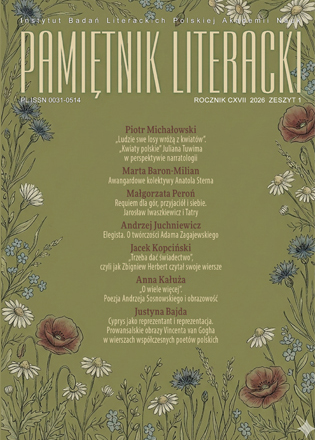
Pamiętnik Literacki 1 / 2026
 Co-financed by the Minister of Culture and National Heritage from the Culture Promotion Fund.
The article is an attempt at a narratological interpretation of Julian Tuwim’s poem, in which the fictional plot is inextricably mixed with an autobiographical thread. As a result, the position of the narrative subject and his position in the world presented are altered, as are those of the personal narrators and focalizers. Though the subject of memories is one of the protagonists and has varying degrees of contact with the characters who participate in the fictional narrative, he also appears in peculiar situations in which the range of information about the deeds of other characters that he possesses cannot be justified by his copresence in the course of action. The autothematic fragment of the poem is treated as a key to the technique of creation employed in the work, but it also complexifies the mechanisms of fictional creation. The figure responsible for that is gardener Ignacy Dziewierski one of the main protagonist, erstwhile third person singular character. A suggestion placed at the end of the piece is that it was Tuwim who conjured all the figures when observing the making of a floral bouquet described in the first lines of the work.
The subject of the paper is a set of various forms of avant-garde collectivity and cooperation in the work of Anatol Stern. Displaying the key contradiction between the collective and the individual tendencies within the avant-garde appears to be an important aspect of the proposed depiction. Baron-Milian analyses the collective creative practices and forms of Stern’s cooperation in the 1920s and later, pointing at those among them he was involved, inter alia, with Aleksander Wat, Bruno Jasieński, Mieczysław Szczuka, Henryk Berlewi, Stefan Kordian Gacki, Stefan and Franciszka Themerson, or Alicja Stern. The article aims to capture the distinctness and diversity practices of collective creativity shown in the perspective of theories of avant-garde group, collectivity and cooperation which were formulated both by avant-garde theoreticians and historians, as well as by artists. Additionally, the author of the paper proposes some possible future directions for research in avant-garde collectivity.
Jarosław Iwaszkiewicz who visited numerous—not only European—countries, also travelled around Poland, and collected his impressions in his pieces and diaries. In “Album tatrzańskie” (“The Tatra Album”), published in 1976, he described the Tatra Mountains as “most beautiful in the world.” The Tatras are one of the most important places in the poet’s internal map as they mark the beginning and the end of the artist’s struggle. Iwaszkiewicz was tied to this range of mountains due to family connections and artistic relations. A 50 year contact with the Tatras brought about the making of the book. The compilation that spans over more than half century is artistically and genetically diversified: it includes lyrical pieces, poetic prose, and memories.
“The Tatra Album” is a valediction to the mountains and to his friends. It is dominated by the passing of time, by irretrievable loss of everything he loved, and by marginal position of his output. The writer, whom many envied his successes, maintenance, and position in culture, bids farewell to his life in sorrow and disappointment.
Juchniewicz in his paper traces the Shoah theme in Adam Zagajewski’s work, when analysing the poet’s selected verse and essayistic texts published from the 1980s. The study consists of several parts: the first contains Zagajewski’s poetry reception, while the remaining ones reveal his interest in the Holocaust. When opinions about the poetry’s affirmativity and Zagajewski’s tendency towards aesthetisation are confronted with poems of interventional and critical character, certain statements of the author remain unnoticed. Giving those statements, Zagajewski takes up the role of not only the poet who speaks in the name of the absent/murdered, but also as a representative of the postmemory generation. This aspect proves vital in searching for the formulas and modes to approach the past through the medium of imagination as a superior category that allows to translocate between temporal planes and to sympathise with the various groups of victims.
Zbigniew Herbert inferred the auctorial style of reading his poems out loud from the philosophical-elegiac tone of his debut volume “Struna światła” (“String of Light”), the proofs of which are in the poet’s radio recitations from the 1960s and 1970s as well as from public performances during evenings with the author from the 1980s. The recorded pieces sound as a Stoic’s substantive lecture about the rule of the world and at the same time a testimony of ethical obligation pronounced over a friend’s coffin. In 1998, at the last recording session, Herbert changed the recitation style of his lyrical pieces into a more personal, strengthening their catastrophic dimension on the one hand, and psychological-lyrical on the other hand. Scriptorial reading of the recorded poems allows to discern the difference in style and to interpret it within the affective mode—an unusual encounter with a transformed poet.
The paper explains the differences that lie between the linguistic order and the pictorial order (imagery) in the poetry of Andrzej Sosnowski, one of the most widely known poets who made their debuts after 1989. The starting point of investigations in pictorial elements of the poems is a presentation of Sosnowski’s language philosophy, characterised by appreciation of language’s bodily beginnings. The subsequent parts of the paper contain descriptions of three cases which show the modes of understanding the picture in this poetic output: first, pictorial items built directly into the poetic collections (“Nouvelles impressions d’Amérique <New Impressions of America>”), second, a pictorial form of writing (“Dom ran <A House of Wounds>”), and third, language imagery (“Sylwetki i cienie <Silhouettes and Shadows>”). In each of the above-mentioned volumes Sosnowski employs a unique context (Henri-Achille Zo’s illustrations ordered by Raymond Roussel to his “Nouvelles impressions d’Afrique”, a Maya book known as the Dresden Codex, and a convention of pastoral images typical of Baroque, respectively), and variously arranges the word-image relationships. In the coda, the author gives an overview as well as problematises special cases of such connections. She also formulates a thesis that language imagery and other cases of using such components lead to viewing Sosnowski’s poetry not only as an autotelic writing that challenges the “outside” of language. It also enters the collective circulations of fantasy, while pictures and imagery anchor language in firm meaning-images.
Vincent van Gogh’s painting has been subject of studies by art and literary historians, culture experts, and conservators. Literature, and especially poetry, is a separate field permeated by the iconosphere of the Dutch artist. The paper presents the meaning of the cypress motif in van Gogh’s Provençal creativity, in the letters to his brother Theo, and the mode of elucidating the elements of Provençal expanse by contemporary Polish poets, inter alia, by Dariusz Bugalski, Mieczysław Dziaczek, Krzysztof Gąsiorowski, Tadeusz Różewicz, Włodzimierz Słobodnik, and Jerzy Wojciechowski. The cypress, which for the painter was most significant representative of Southern France, in the poems by Polish poets gains a new interpretation: identified with the figure of van Gogh, it becomes a representation of the painter himself.
The paper offers a proposal to synthesise the floral motifs in Krystyna Miłobędzka’s poetry. An analysis of such verses and themes leads to forming a conclusion that the speaking subject employs these motifs to express the need to stick to the inhuman sphere, but also the belief into the power and immortality of plants. The balance between weak/invincible grass and power/ changeability of a tree forms in the poems a poetics of relation with the plant element. The biophilia, which is inscribed into Miłobędzka’s pieces, also shows the aporias that lay at the foundation of her identity construction.
The main purpose of the treatise is to consider the scope of influence of Velimir Khlebnikov’s poetry on Julian Tuwim’s poetic creativity, Tuwim Russian-language reception in the context of Khlebnikov’s output, and the Polish translations of the futurian’s word-forming poems in the perspective of Tuwim’s verses. Adam Pomorski’s strategy of stylistic reminiscence which he employed in his translation allows not only to deepen Khlebnikov’s relations with Tuwim’s poetic idiolect, but also to highlight the possibilities of the still actual literary tradition of target culture in new comparative contexts: linguistic-stylistic, thematic, and historical.
The article is an attempt at a multilayer description of Witold Wirpsza’s collection “Komentarze do fotografii »The Family of Man«” (“Comments to the Photograph »The Family of Man«”), which is interpreted in the context of literary-cultural interface. Grzegorz Olszański discusses the evolution of research in the connections between the two domains, and points at the iconic turn and the material turn, both of which added to the development of this research perspective. The centre of attention is occupied by the poet’s emotional reaction to the famous Edward Steichen’s exhibition and by the question about a possible of translation of what is affective into a literary text. The paper contains an analysis of the “affective poetics” and a presentation of Wirpsza’s method to deconstruct the myth of photography as a commonly understandable and universal language.
The paper discusses the project of independent Poland culture that emerges from the materials of “Ostoja” (“Mainstay”) Publishing Company and the editorial correspondence of “Zdrój” (“Spring”), including handwritings, in the months before its establishing and in the initial period of its Poznań biweekly release (1917–1918). It points at a frequent publication of German authors, which was interpreted in reference to the prominent in the material discourse about the Polish-German cultural transfer. In the periodical edited by Jerzy Hulewicz, Polish culture is viewed as inclusive, devoid of ressentiments and defining itself as a part of European culture, whilst the reason to formulate such a diagnosis is its attitude to German culture that trespasses the colonial events. Employing the optic of postcolonial studies allows for presenting the editorial’s concept as an idea that would strikingly develop only in the independent Poland.
The paper explains the circumstances of Antoni Słonimski’s literary and journalistic debut. Piotr Sitkiewicz observes how Słonimski himself and the scholars following his trace depict the moment of his entering the literary stage, and then, based on press search queries, delivers the facts referring to the publication of the poet’s first pieces. As is proven, in the year 1918, which is usually treated as the date of his true debut, Słonimski was an author with considerable and diverse artistic achievements. To settle the problem of Słonimski’s literary debut, Sitkiewicz suggests a division into bibliographical debut and institutional debut, which allows for a more precise description of the complex matter.
The review is a discussion of Rozalia Wojkiewicz’s book “W spektrum Wyspiańskiego. Witraż w poezji Młodej Polski” (“In Wyspiański’s Spectrum. Stained-Glass Window in the Poetry of Young Poland,” 2022). The monograph has been recognised as the most vital literary-historical achievement published in recent years. The researcher explores the subject that has to this day occupied the margins of studies in the poetry of the turn of the century, and she situates it in the context of Stanisław Wyspiański’s letters and numerous examples of Young Poland’s pieces that take up the subject of stained-glass window motif.
This review paper is a description of Agata Stankowska’s monograph “Ikona i trauma. Pytania o »obraz prawdziwy« w liryce i sztuce polskiej drugiej połowy XX wieku” („Icon and Trauma. The Problem of the »True Image« in Late 20th Century Polish Poetry and Art,” 2019)—an analysis of, inter alia, Tadeusz Różewicz’s, Ewa Kuryluk’s, Tadeusz Kantor’s and Jerzy Nowosielski’s output, as well as the first on the Polish ground depiction of the pictorial turn in cultural history. Stankowska’s considerable achievement consists of an analysis of the Vernicle and apophatic poetics—the categories applied by various artists pursuing a career in literature as well as in arts. The article aims to point at the innovative features of the monographs and at the detailed description of their application to the analysis of the works by the mentioned male and female writers.
The article discusses Joanna Gromek-Illg’s biography of Wisława Szymborska entitled “Szymborska. Znaki szczególne. Biografia wewnętrzna” („Szymborska. Distinguishing Marks. An Internal Biography”). The reviewer situates the book in the contexts of biographical writing and methodological transformations in contemporary humanities. She also pays attention to the hermeneutical dimension of Szymborska’s latest biography as to both epistemological and ethical project.