Archives
Pamiętnik Literacki 3 / 2026
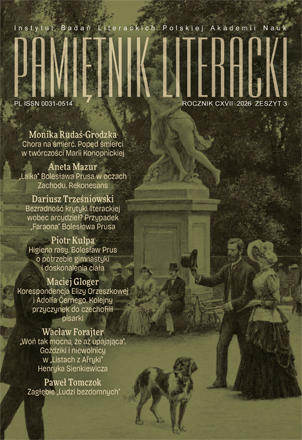
Pamiętnik Literacki 3 / 2026
 Co-financed by the Minister of Culture and National Heritage from the Culture Promotion Fund.
The motif of death belongs to the permanent elements of Maria Konopnicka’s creativity. On the one hand, Konopnicka made deliberate choices when choosing the theme, while on the other hand her poems voiced fascination with death—a manifestation of urge. Due to that, her writing is worth viewing from the psychoanalytical perspective, especially in the light of Jacques Lacan’s concept of death drive, being a modification of the Freudian idea of Todestrieb. Contemporary psychoanalytical interpretations which derive from the Lacanian School of Psychoanalysis depart from differentiating between Eros and Thanatos for the concept of one drive, accentuating its function as an indirect way around emptiness that plays a vital role in shaping subjectivity. This drive, situated on the borderline between the body and the psyche, expresses through irresistible drive and is realised through repetition. In Konopnicka’s writing, the tension demonstrates both in the topics she adopted and in the formal, stylistic, and versification means of expression that she employed.
Invariably, Bolesław Prus’ “Lalka” (“The Doll”) has recently occupied a high position not only in Internet reading rankings. Delayed translations and Eastern reception (from the 1960s to intensive reduction of backlogs in the last decades), often inspired by the Polish emigrants, do not always reflect their presence in scientific/cultural circulation. The material includes occasional, though valuable reception of the novel (its filming) in France; scanty knowledge, in spite of two translations, in Germany (“The Doll” in the shadow of Russian prose); and a more marked response in the English-speaking world (Great Britain, the USA). “Discovering” “The Doll” (also on the occasion of Prus’ death centenary in 2012), the West has a multifold image of the novel: as an underestimated, universal masterpiece of the European canon, a fascinating exoticism of the peripheries, or a distant relative of the great French or Russian 19th c. prose.
“Faraon” (“The Pharaoh”) surprised both its readers and first literary critics. The novelist made a shift into historical issues which he to that day avoided since only the short story “Z legend dawnego Egiptu” (“A Legend of Old Egypt”) undertook the subject of anyway allegorically and conventionally handled past. Attempts were made to find the keys that update the problems raised in “The Pharaoh,” alongside observations that it was a political or social novel clad in a historical costume. Distant, even Enlightened patterns were indicated, and kinship with the popular novel pointed out. Apart from rare exceptions (Leon Winiarski), “The Pharaoh” received positive though humble assessments which in majority agreed that Prus’ position in Polish literature is founded on his erstwhile achievements. The real end of the 19th c. (The Great War, the fall of socio-political order, the birth of Polish statehood, customary changes) was essential to appraise “The Pharaoh” as a text about the state, politics, society, and emotions. Its successful and also international career dates to the later decades of the 20th c. and the beginning of the 21st century.
The paper describes Bolesław Prus’ attitude towards the issue of racial hygiene. The writer, who in the Warsaw circles was known for his fight for health and awareness of the poorest social strata, following Charles Darwin, Ernst Haeckel, and Herbert Spencer, redefined the norms of building male-female relationships, and for transferring genes to offsprings with the sense of biological responsibility. Prus, referring to the modern understanding of sport and practical applicability of natural sciences, regularly repeated his key utopian vision about creating a more perfect man who might successfully take part in the fight for existence.
The article contains an edition of existing correspondence between Eliza Orzeszkowa (1841–1910), a positivist writer, and Adolf Černý (1864–1952), an outstanding activist for Slavic reciprocity, ethnographer supporting Lusatian Serbs in sustaining their national awareness, politician, and poet. The letters make up an important set of documents about Polish-Czech cultural and political relationships. For Orzeszkowa, establishing intensive and sincere contacts with Czech writers was a vital and enduring aspect of her positivist social and cultural engagements. By contrast, for Černý, polonophilia and maintaining contacts with Polish humanists became a part of the Czech Slavic policy and also a nation-forming factor.
The paper is an analysis of the meanings hidden in the literary description of the clove and its common cultivation in Zanzibar. Employing the tools of the 19th c. cultural theory and Eastern African social and political history, Wacław Forajter attempts to reconstruct the contexts of Henryk Sienkiewicz’s accounts, paying special attention to ethnical stratification of these societies, plantation agriculture, and slavery—indispensably tied to it and fought in the second part of the 19th c. by the Western countries—as well as the consequences of the issue for the continent inhabitants.
The paper attempts to reconstruct the literary discourse about The Dąbrowa Coal Basin in the last years of the 19th century. At that time the small region was undergoing rapid industrialisation, which resulted in destruction of natural environment and initiated numerous social problems. Industry development and the changes it brought about allowed to locate the representatives of the Polish intelligentsia on important positions, due to which The Basin attracted a few men of letters who issued new narrations about this place. The article includes the outcomes of research in the place of action of Stefan Żeromski “Ludzie bezdomni“ (“Homeless People”). Identifying some of the loci leads to a deeper understanding of the historical and social context of the novel and testifies to Żeromski’s perfect orientation in the space he was describing. Reconstruction of industrial discourse based on other works of literature composed at the same time explains the fact that the mode of describing The Dąbrowa Coal Basin that the writer chose was one of a few available.
The paper includes a publication of documents referring to Adam Mickiewicz’s children, prepared by Russian police officers after the poet’s death. Some of files relate to copyrights given to children to allow publishing Mickiewicz’s texts on the territory of the Russian Empire, since after the Crimean War the absolute ban on printing Adam’s works was removed. The second part of the paper collects the police reports about the conduct of Władysław Mickiewicz and the poet’s daughters who decided to pay a visit to their relatives in the father’s whereabouts.
The article focuses on the oeuvre of Sygurd Wiśniowski (1841–1892), a widely-read journalist, man of letters and writer of the second half of the 19th c., today almost completely forgotten. His writing was highly valued by, inter alia, Józef Ignacy Kraszewski, with whom he exchanged letters between 1887 and 1881, Maria Konopnicka, and Henryk Sienkiewicz—his close acquaintance. The study contains a comprehensive register of Wiśniowski’s texts published in Poland and in Polish community press abroad, edition of books, and some of his letters. The aim of the present paper is completing a possibly full collection of Wiśniowski’s literary endeavours scattered in hundreds of press publications, and that is designed to greatly facilitate further research of life and output of the noteworthy figure.
This article revisits the bibliographical works of Firmin Maillard, Jules Lemonnyer and Albert Gagnière, who, in the 1870s, took on the task of identifying printed materials relating to either the Paris Commune itself or to the year 1870–1871 (electoral documents, newspapers, printed ephemera, caricatures). It explores the extent to which these bibliographies intersect with the preoccupations of literary history. After presenting the corpus and pointing out that the three authors’ approach suggests a competitive, rather than complementary, relationship between the historical method and literary perspective, it highlights how these bibliographical works can be seen as prologues to a “literary history in the minor mode”, in that they do justice to lesser genres and authors, rely on an implied periodisation of literary history, and grant this printed material the longevity which it seemed to be constitutively lacking.
The paper, in its fundamental part, is an edition of two unknown memories by Bolesław Leśmian’s daughter, Maria Ludwika Mazurowa, about Zofia Chylińska-Leśmianowa. Original papers are treasured in The Library of The John Paul II University in Lublin as the heritage of Zdzisław Jastrzębski—the originator and editor of a collection of memories about Leśmian. The publication was issued in Wydawnictwo Lubelskie in 1996. Leśmian’s daughter planned to effectuate a separate book about her mother, but the plans were not realised. Materials of this kind not only complement our knowledge about the complex lot of the poet’s family, but first and foremost they shed light on the achievements of Zofia Chylińska-Leśmianowa—a well-educated and original painter.
The subjects of research presented in the study are death notices published in the years 1888–1917 in the section “Kronika żałobna” (“Obituaries”) of “Józefa Czecha Kalendarz Krakowski” (“Józef Czech’s Cracow Calendar”). The excerpted almanacs are here viewed as valuable documents of everyday life, on the basis of which we may reconstruct the modes of thinking and communicating about the man and the woman at the end of the 19th c. and at the beginning of the 20th c., as well as the then methods of categorising information about sex and cultural, customary, and etiquette patterns connected with it. A linguistic analysis of 2869 death notices reveals numerous qualitative and quantitative asymmetries in writing about males and females. Studies in historical sources reveal, e.g. high frequency of texts presenting women from private, family, and maritonymic perspective, depicting a woman as somebody’s wife or a widow. A deceased man is viewed from a public perspective, while family issues remain marginal.
This article presents the life and work of Zofia Mrozowicka, a prominent poet and writer active in Lviv at the turn of the 19th and 20th centuries. Her literary contributions, closely intertwined with her civic engagement, reflect a deep commitment to the moral and intellectual formation of the younger generation. At the same time, they exemplify the broader, often underacknowledged, culture-forming role of women in the public life of Galicia. Women writers in Lviv were not solely engaged in literary activity; many, including Mrozowicka, actively participated in social initiatives aimed at supporting the marginalised and advancing civic consciousness. Throughout her life, Mrozowicka consistently integrated her literary practice with a strong sense of public duty. In addition to her original works, she was involved in publishing initiatives directed at youth audiences—texts frequently educational in tone and imbued with patriotic values. Through her dual engagement in literature and social activism, she played a meaningful role in shaping the moral and national awareness of Galicia’s young generation, leaving a lasting mark on the cultural landscape of her time.
Against the background of the previous compendiums about women writers, the state of research in the first half of the 19th c. is still inextensive. An analysis of the 19th c. and 20th c. studies (e.g. by Jan Sowiński, Karol Estreicher, Adam Bartoszewicz, Piotr Chmielowski); editions such as “Nowy Korbut” (“New Korbut”), “Dawni pisarze polscy” (“Old Polish Writers”), “Polski słownik bibliograficzny (Polish Bibliographical Dictionary), and the series “Obraz Literatury Polskiej” (“Image of Polish Literature”) made way to prepare an updated catalogue of names that serves as a basis for “Słownik polskich autorek, tłumaczek i wydawczyń. Lata 1795–1863” (“Dictionary of Polish Women Authors, Translators, and Publishers. 1795–1863”) prepared from the end of October 2025 in University of Łódź within the framework of the grant National Programme for the Development of Humanities. The article describes the criteria adopted to realise the project and the phases of work that must be accounted for. It also stresses that though some of the biobibliographical entries have already been prepared and published, in majority their content deserves supplementation and corrections in the form of source reassumption and in-depth research queries. The new compendium is a desired endeavour, even a necessary one, as it aims to offer a reasonable basis for further meticulous research in literary studies.
A German translation of “Quidam” (Berlin 2022) was accomplished by professor Rolf Fieguth, an outstanding expert in Polish Romanticism, a Adam Mickiewicz scholar, but also a researcher in Polish literature over a span of centuries from the Renaissance to the present day; additionally, one of those philologists fascinated by Cyprian Norwid who spent most of their academic life investigating the poet’s work. This professor at the University of Fribourg, Switzerland, for many years acquired knowledge about “Quidam” and penetratingly explored numerous clarifications. To what extent was the expertise helpful when translating Norwid’s hermetic parable, and to what extent a burden? Does explication of the various senses prevail over the insight into Norwid’s exceptional poetic phrase?
The review refers to the writings of Julian Kaliszewski (Klin), the first edition of which was prepared by Dobrosława Świerczyńska under the title “Moi kochani rodacy! i inne pisma” (“My Beloved Fellow Countrymen! and Other Writings,” 2023). Wiktoria Godlewska—the reviewer—reveals the significance of this endeavour, exhibits the editorial practice and pays attention to the merit of the material. She also convinces that the volume opens many important fields of reflection over Kaliszewski’s output. In the ultimate part, she tries to attribute the authorship of the columns entitled Nory (Dens) and “Życie warszawskie” (“Warsaw Life”) published in “Kurier Codzienny” (“Daily Courier”) in 1879 that in this publication are attributed to Kaliszewski. The outcomes of stylometric analysis show that the pseudonym “Nieznajomy” (“Unknown”), with which the cycles were signed, refers most probably to Wiktor Gomulicki.
The review assesses the first critical rendering of Henryk Sienkiewicz’s novel “Wiry” (“Whirlpools,” 2024) edited by Tomasz Sobieraj, prepared within the framework of National Programme for the Development of Humanities, and directed by Jolanta Sztachelska. The design of this impression reveals the necessary compromises between the tradition (models proposed by Konrad Górski and by Roman Loth) and modernity (literary genetic criticism, John Bryant’s theory of fluid text) which prove most operative for digital editions. What the reviewer sees as most valuable elements of the publication are a comprehensive introduction showing the genesis and the text’s critical reception (evaluated from the viewpoint of ideological-political significance), as well as “Textological commentaries”—a discussion about the changes, modifications, and relinquished auctorial conceptions derived from fragments of preserved drafts of the novel.
The text refers to Justyna Bajda’s book “Błękitny »fin de siècle«. Kolor niebieski w kulturze i literaturze Młodej Polski (Gabriela Zapolska—Kazimierz Przerwa-Tetmajer—Stanisław Wyspiański)” („The Blue Fin de Siècle”) published in 2023 by University of Wrocław Press. The review discusses such issues as the research subject (selected Young Poland’s literary pieces, material culture and the art of the turn of the 19th and the 20th c.), Bajda’s line of research, argument composition, documentation of theses. Additionally, it traces the modes of exposing the respective research problems: the functioning of the colour blue (and its shades) in culture, art, fashion of the turn of the centuries, and the perception of this colour as a tool used to depict the expanse of the city, interiors, as well as nature and Young Poland’s journalism and literature—in selected pieces by Gabriela Zapolska, Kazimierz Przerwa--Tetmajer, and Stanisław Wyspiański. The role of rich pictorial material included into the publication also occupies the reviewer’s attention.